
 400-0559-095
 中文/EN
中文/ENIndustrial Application Quadruped Robot
Hazardous environment monitoring covers toxic gas leaks, structural collapses, and chemical spills—situations where sending people first can create significant risks. Choosing the right quadruped robot requires matching its sensors, durability, and capabilities to the specific hazard.
This guide explores the key factors in selecting a rescue robot dog and how DEEP Robotics’ rescue solutions support safer operations in complex environments.
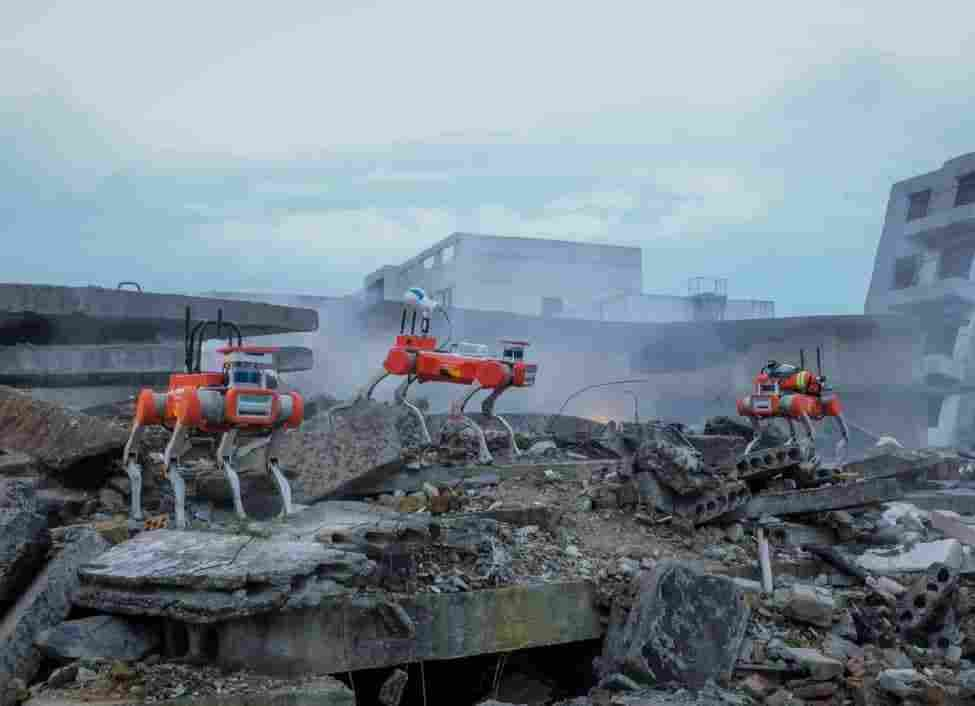
Hazardous environment monitoring differs from standard inspection because the risks are often unpredictable and may involve more than difficult terrain. Robots used in these conditions must handle threats such as toxic substances, unstable structures, extreme temperatures, and limited visibility.
In hazardous areas, conditions may be unknown until someone enters the site. A robot that can move ahead, collect visual and environmental data, and report back allows teams to better understand the situation before committing personnel.
When monitoring relies only on human entry, workers and responders may face unnecessary exposure to dangerous conditions before the environment is fully assessed. Rescue robot dogs help reduce these risks by providing information from areas that may be unsafe or difficult to access.
Common hazardous monitoring scenarios include:
· Toxic gas leaks or oxygen-deficient environments
· Structural collapse and disaster response areas
· Chemical spills and industrial contamination
· Extreme temperature or fire-related inspection
· Tunnels, mines, and other confined spaces
Choosing a rescue robot dog for hazardous monitoring requires evaluating factors such as sensor capability, durability, mobility, payload capacity, and modularity. Each factor affects how effectively the robot can collect information and support operations in high-risk environments.
Sensor payload determines what hazards a robot can detect and report. A suitable detection module should support monitoring risks such as carbon monoxide, carbon dioxide, oxygen deficiency, combustible gases, nitrogen oxides, and hydrogen sulfide (H2S).
Thermal detection is also valuable in low-visibility environments. A bi-spectrum camera combines infrared and visible-light imaging to help operators identify temperature differences and better understand site conditions remotely.
Hazardous sites often involve uneven terrain, dust, water exposure, and extreme temperatures. A robot with strong environmental protection and mobility can operate more reliably in conditions where traditional inspection methods may be limited.
For example, DEEP Robotics X30 features IP67 protection and an operating temperature range of -20°C to 55°C, supporting inspection and rescue tasks in demanding environments.
Load capacity determines whether a robot can support tasks beyond observation. Some platforms can transport emergency equipment or additional sensing devices into areas that may be unsafe for personnel.
Modularity is also important because different hazards require different tools. A robot with flexible payload options can be equipped with sensors such as thermal cameras, gas detectors, LiDAR, or other inspection modules based on the mission requirements.
Criteria | Why It Matters | What to Look For |
Sensor payload | Determines what hazards the robot can actually detect and report | Multi-gas detection (CO, CO2, combustible gas, NOx, H2S) plus bi-spectrum thermal/visual imaging |
Durability | Hazard sites rarely offer clean, dry, flat conditions | IP-rated dust/water protection and a wide operating temperature range |
Load capacity | Determines whether the robot can assist, not just observe | Ability to carry supplies such as oxygen cylinders or medical kits |
Modularity | A single hazard rarely stays the same call to call | Swappable sensor modules for different hazard types |
Among DEEP Robotics’ rescue robot dog platforms, the X30 and X30 Pro are designed for inspection and rescue scenarios where mobility, environmental protection, and adaptability are important considerations.
Both platforms feature IP67 protection and all-terrain mobility for challenging environments. The X30 series supports operation from -20°C to 55°C and can integrate additional equipment such as sensing modules for different monitoring requirements.
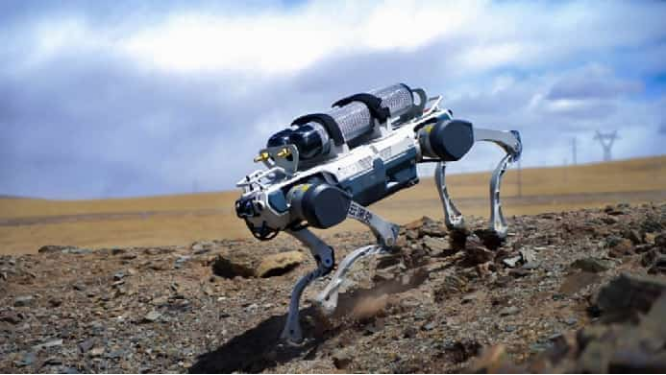
These capabilities provide useful reference points when evaluating industrial quadruped robots for hazardous environment monitoring.
Spec | X30 | X30 Pro |
Ingress protection | IP67 | IP67 |
Obstacle / stair height | ≥20cm | ≥20cm |
Slope climbing | ≤45° | ≤45° |
Operating temperature | -20°C to 55°C | -20°C to 55°C |
Weight | 56kg(battery included) | 59kg(battery included) |
1. Rescuers deploy the quadruped robot dog toward the hazardous area.
2. The robot is remotely controlled from a safe operation zone or command center.
3. The robot enters the hazardous environment to collect on-site information.
4. Images and environmental data are transmitted back to the detection system in real time.
5. Onboard sensors detect hazardous gases and collect temperature information through thermal imaging.
6. The collected data helps rescue teams assess conditions, plan safer operations, and support rescue tasks.
This workflow combines several key modules:
· Bi-spectrum camera: Combines infrared and visible-light imaging for remote visual inspection.
· Gas sensor: Detects hazardous gases and provides real-time concentration information.
· Smart controller: Supports navigation, mapping, and localization functions.
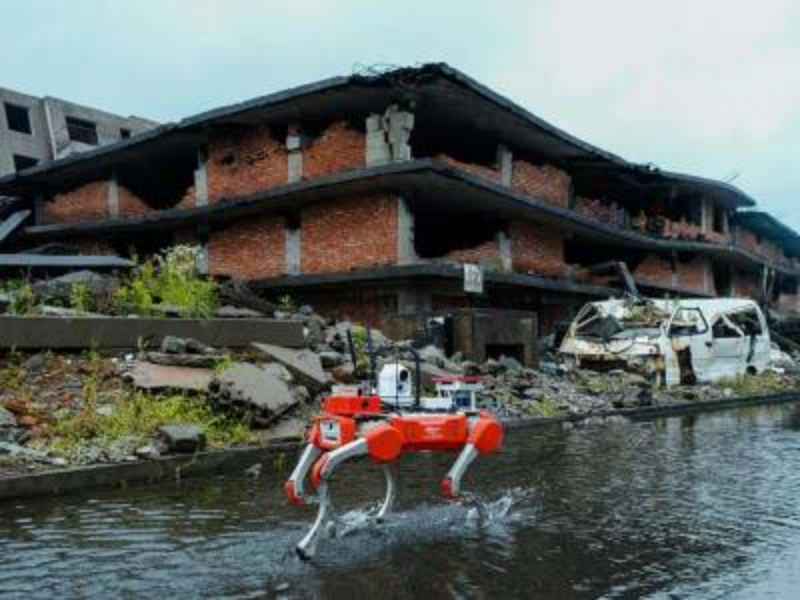
DEEP Robotics designed this hazard rescue solution for challenging scenarios such as post-earthquake areas, collapsed buildings, tunnel accidents, and chemical contamination environments.
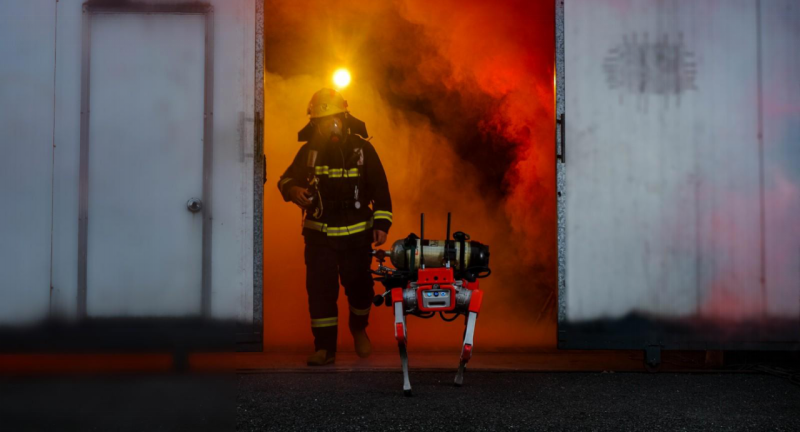
A practical example came from the 2024 Emergency Mission drill in Zhejiang Province, China. During the exercise, a fire brigade worked with DEEP Robotics to deploy an X30 quadruped robot dog alongside a drone for chemical explosion hazard scouting. The robot helped collect environmental information in a simulated factory accident involving flooding and hazardous chemical fires, supporting safer rescue operations.
Choosing a quadruped robot for hazardous environment monitoring depends on matching its capabilities to the risks your site faces. Key factors include sensor options, environmental protection, mobility, and payload requirements.
Before selecting a platform, consider:
· Does the sensor system cover the hazards you need to monitor?
· Can the robot operate reliably in your environmental conditions?
· Can it support the equipment and tasks required for your mission?
· Can its payload be adapted for different scenarios?
A suitable quadruped robot should provide the right combination of sensing, durability, and flexibility to support safer operations in complex environments.

 Wechat
 Bilibili
 LinkedIn
 Youtube
 Twitter
 Douyin





 浙公网安备:33010602009611